Author

admin

Browsing

Apollo Silver Corp. (‘ Apollo Silver ‘ or the ‘ Company ‘) (TSX.V:APGO, OTCQB:APGOF, Frankfurt:6ZF0) is pleased to announce the Company has closed the final tranche of its previously announced upsized non-brokered private placement (the ‘Upsized Offering’), raising gross proceeds of $1,641,503 through the issuance of 455,973 units (the ‘Units’) of the Company at a price of $3.60 per Unit. The Company previously closed the first tranche of the Upsized Offering, as announced in its October 22, 2025 press release, for gross proceeds of $25,134,145. In aggregate, the Upsized Offering raised total proceeds of $26,775,648 through the issuance of 7,437,680 Units.

Each Unit issued pursuant to the Upsized Offering consists of one common share (a ‘Share’) in the capital of the Company and one common Share purchase warrant (a ‘Warrant’). Each Warrant entitles the holder thereof to purchase one Share at an exercise price of $5.50 for 24 months from the closing date of the Offering. The Warrants will be subject to an acceleration provision, such that if at any time after the date that is four months and one day after the closing, the Company’s Shares trade on the TSX Venture Exchange (the ‘TSXV’) at a closing price of $7.50 or greater per Share for a period of ten (10) consecutive trading days, the Company may accelerate the expiry of the Warrants by giving notice to the holders thereof and, in such case, the Warrant will expire on the thirtieth (30th) day after the date of such notice (the ‘Acceleration Provision’).

The Company would like to thank existing and new shareholders including Eric Sprott, Primevest Capital, Sprott Asset Management, Commodity Capital, Jupiter Asset Management and others for their continued support through participation in this financing.

‘We are very pleased with the strong interest in our private placement and deeply appreciate the confidence shown by the institutional, retail, and strategic investors who have backed management’s vision to advance our Tier 1 assets,’ said Ross McElroy, President & CEO of Apollo Silver. ‘The funds raised from this financing position the Company well to advance our Calico Silver Project in San Bernardino County, California, and to support ongoing efforts toward securing surface access and advance the Cinco de Mayo Project in Chihuahua, Mexico.’

In connection with subscriptions received in the Upsized Offering, the Company will pay aggregate finder’s fees totaling $901,395.18, payable in cash and/or Units to BMO Capital Markets, Canaccord Genuity, Red Cloud Securities Inc., Research Capital Corporation and SCP Resource Finance.

The securities issued under the Upsized Offering are subject to a four-month hold period from the date of closing. The Company intends to use the net proceeds from the Upsized Offering to continue advancing the Calico Silver Project in San Bernardino, California; support community relations initiatives at the Cinco de Mayo Silver Project in Chihuahua, Mexico; cover ongoing property maintenance costs at both projects; and for general corporate purposes. The Upsized Offering remains subject to the final approval of the TSXV.

The Offering included participation by certain insiders of the Company for an aggregate of 405,557 units totaling gross proceeds of $1,460,005.20. Such participation constitutes a ‘related party transaction’ under Multilateral Instrument 61-101 – Protection of Minority Security Holders in Special Transactions (‘MI 61-101’). The issuance of securities to insiders is exempt from the valuation requirement pursuant to section 5.5(b) of MI 61-101, as the Company’s shares are not listed on a specified market, and from the minority shareholder approval requirement pursuant to section 5.7(a) of MI 61-101, as the fair market value of the securities issued to related parties does not exceed twenty five percent of the Company’s market capitalization.

The Shares have not been, and will not be, registered under the United States Securities Act of 1933, as amended (the ‘U.S. Securities Act’), or any U.S. state securities laws, and may not be offered or sold in the United States without registration under the U.S. Securities Act and all applicable state securities laws or compliance with the requirements of an applicable exemption therefrom. This news release shall not constitute an offer to sell or the solicitation of an offer to buy securities in the United States, nor shall there be any sale of these securities in any jurisdiction in which such offer, solicitation or sale would be unlawful.

About Apollo Silver Corp.

Apollo is advancing one of the largest undeveloped primary silver projects in the US. The Calico Silver Project hosts a large, bulk minable silver deposit with significant barite and zinc credits – recognized as critical minerals essential to the US energy and medical sectors. The Company also holds an option on the Cinco de Mayo Project in Chihuahua, Mexico, which is host to a major carbonate replacement (CRD) deposit that is both high-grade and large tonnage. Led by an experienced and award-winning management team, Apollo is well positioned to advance the assets and deliver value through exploration and development.

Please visit www.apollosilver.com for further information.

ON BEHALF OF THE BOARD OF DIRECTORS

Ross McElroy
President and CEO

For further information, please contact:

Email: info@apollosilver.com

Telephone: +1 (604) 428-6128

Neither the TSX Venture Exchange nor its Regulation Services Provider (as that term is defined in the policies of the TSX Venture Exchange) accepts responsibility for the adequacy or accuracy of this release.

Cautionary Statement Regarding ‘Forward-Looking’ Information

This news release includes ‘forward-looking statements’ and ‘forward-looking information’ within the meaning of Canadian securities legislation. All statements included in this news release, other than statements of historical fact, are forward-looking statements including, without limitation, statements with respect to the intended use of proceeds from the Upsized Offering; receipt of final approval from the TSXV; the advancement and potential of the Company’s Calico Project and Cinco de Mayo Project; the Company’s plans and expectations relating to exploration, permitting, and future development activities at Calico and Cinco de Mayo; efforts to obtain and maintain surface access and community support at Cinco de Mayo; and the anticipated benefits to the Company and its shareholders. Forward-looking statements include predictions, projections and forecasts and are often, but not always, identified by the use of words such as ‘anticipate’, ‘believe’, ‘plan’, ‘estimate’, ‘expect’, ‘potential’, ‘target’, ‘budget’ and ‘intend’ and statements that an event or result ‘may’, ‘will’, ‘should’, ‘could’ or ‘might’ occur or be achieved and other similar expressions and includes the negatives thereof.

Forward-looking statements are based on the reasonable assumptions, estimates, analysis, and opinions of the management of the Company made in light of its experience and its perception of trends, current conditions and expected developments, as well as other factors that management of the Company believes to be relevant and reasonable in the circumstances at the date that such statements are made. Forward-looking information is based on reasonable assumptions that have been made by the Company as at the date of such information and is subject to known and unknown risks, uncertainties and other factors that may have caused actual results, level of activity, performance or achievements of the Company to be materially different from those expressed or implied by such forward-looking information, including but not limited to: risks associated with mineral exploration and development; metal and mineral prices; availability of capital; accuracy of the Company’s projections and estimates; realization of mineral resource estimates, interest and exchange rates; competition; stock price fluctuations; availability of drilling equipment and access; actual results of current exploration activities; government regulation; political or economic developments; environmental risks; insurance risks; capital expenditures; operating or technical difficulties in connection with development activities; personnel relations; and changes in Project parameters as plans continue to be refined. Forward-looking statements are based on assumptions management believes to be reasonable, including but not limited to the price of silver, gold and barite; the demand for silver, gold and barite; the ability to carry on exploration and development activities; the timely receipt of any required approvals; the ability to obtain qualified personnel, equipment and services in a timely and cost-efficient manner; the ability to operate in a safe, efficient and effective matter; and the regulatory framework regarding environmental matters, and such other assumptions and factors as set out herein. Although the Company has attempted to identify important factors that could cause actual results to differ materially from those contained in forward-looking information, there may be other factors that cause results not to be as anticipated, estimated or intended. There can be no assurance that forward-looking statements will prove to be accurate and actual results, and future events could differ materially from those anticipated in such statements. Accordingly, readers should not place undue reliance on forward looking information contained herein, except in accordance with applicable securities laws. The forward-looking information contained herein is presented for the purpose of assisting investors in understanding the Company’s expected financial and operational performance and the Company’s plans and objectives and may not be appropriate for other purposes. The Company does not undertake to update any forward-looking information, except in accordance with applicable securities laws .

News Provided by GlobeNewswire via QuoteMedia
This post appeared first on investingnews.com

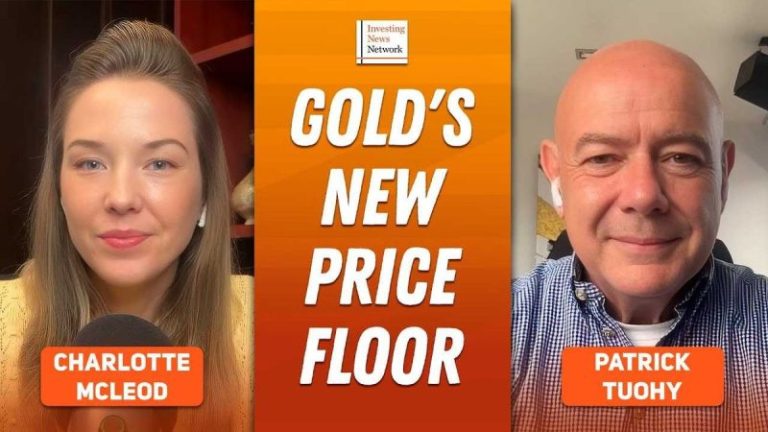
Patrick Tuohy, global head of sales and marketing Goldstrom, shares his outlook for gold, saying its position as a store of value has been reestablished.

In his view, the yellow metal has found a new price floor at US$3,000 per ounce.

Securities Disclosure: I, Charlotte McLeod, hold no direct investment interest in any company mentioned in this article.

This post appeared first on investingnews.com

Newmont (NYSE:NEM,ASX:NEM) announced that its Ahafo North project in Afrisipakrom, Ghana, has officially entered commercial production, following the site’s first gold pour last month.

Located about 50 kilometers from Newmont’s existing Ahafo South operation, the Ahafo North mine is expected to produce approximately 50,000 ounces of gold by the end of 2025 before ramping up through 2026 to reach full operational capacity.

Over the next five years, the mine is forecast to deliver between 275,000 and 325,000 ounces of gold annually over a projected 13-year mine life. Newmont also added that once integrated with Ahafo South, the Ghana operation is projected to yield around 750,000 ounces of gold per year.

“Achieving commercial production at Ahafo North represents a significant milestone for Newmont and our partners in Ghana,” said Tom Palmer, Newmont’s president and chief executive officer.

Ore stockpiling began in late 2024, with critical facilities—including processing circuits, mining support infrastructure, and a tailings storage system—completed ahead of schedule.

“It’s rare in our industry to see a new mine come to life within a single career,” Palmer added. “I’m incredibly proud of what our teams have achieved and honored to have been part of this project from the very beginning.”

Ahafo North becomes Newmont’s second operating site in Ghana, following the company’s divestment of the Akyem mine in April this year.

Overall, the mine represents the company’s third major investment in the country and is designed to leverage operational synergies with Ahafo South.

The project has also had a substantial economic impact in Ghana. Construction activities generated roughly 4,500 contracted jobs, and the transition to operations has created about 560 permanent and 1,000 contracted positions.

With commercial operations now underway, Ahafo North stands as a cornerstone asset in Newmont’s global portfolio.

“As we progress with full-scale operations, our focus remains on generating enduring value for our shareholders, workforce, host communities, and the government of Ghana,” Palmer said.

Securities Disclosure: I, Giann Liguid, hold no direct investment interest in any company mentioned in this article.

This post appeared first on investingnews.com

Copper prices edged closer to record highs this week, driven by renewed optimism over an impending trade accord between the US and China and concerns about tightening global supply as major producers face output disruptions.

On the London Metal Exchange (LME), copper traded around US$11,029 a ton on Tuesday (October 28) roughly US$80 below the all-time high of US$11,104.50 set in May last year.

Copper futures on COMEX also climbed to as high as US$5.247 per pound, or roughly US$11,568 per metric ton, while currently settling at US$5.1395. This places them close to the record level of US$12,330 per ton reached in July.

Futures in New York also advanced as much as 2.4 percent earlier this week, buoyed by signs that Washington and Beijing are moving to ease trade tensions that have weighed on global growth.

Negotiators from both sides concluded talks over the weekend that appear to have set the stage for a sweeping agreement for Presidents Donald Trump and Xi Jinping to finalize later this week at a summit in South Korea.

US Treasury Secretary Scott Bessent confirmed that Trump’s threat of 100 percent tariffs is ‘off the table,’ and Beijing has agreed to pause for a year its plan to expand rare earth export controls.

Copper in general has rallied by about 25 percent this year, recovering from last year’s selloff triggered by escalating trade tensions. The rally has been amplified by a string of supply disruptions across key producing regions, from South America to Central Africa and Southeast Asia.

At the same time, the dollar’s weakness has given an additional lift to copper prices, making dollar-denominated commodities more attractive. The US currency has fallen more than 7 percent since January amid growing market expectations of further Federal Reserve rate cuts.

But while demand optimism is back, the supply picture remains fragile. Anglo American (LSE:AAL,OTCQX:NGLOY) warned this week that copper production from its flagship Collahuasi mine in Chile will likely fall short of expectations in 2026, further straining an already tight market.

Anglo had previously projected production to rise to as much as 470,000 tons from between 380,000 and 410,000 tons this year, but said it expects a recovery only by 2027.

In its latest quarterly results, Anglo also reported a 9 percent decline in copper output over the first nine months of the year, producing 526,000 tons compared with 575,000 tons in the same period of 2024.

Still, it maintained its full-year guidance of 690,000 to 750,000 tons of copper and raised its outlook for iron ore output after completing pipeline inspections at its Minas-Rio operation in Brazil ahead of schedule.

The company’s muti-billion merger with Canada’s Teck Resources (TSX:TECK.A,NYSE:TECK) last month continues a consolidation trend in the industry as producers seek to secure future copper supply driven mainly by the clean energy transition and the AI-driven data infrastructure boom.

Copper is essential for renewable energy systems, electric vehicles, and power grids, all of which are expanding rapidly. BHP, the world’s largest miner, estimates that global copper demand could surge by around 70 percent by 2050.

Analysts believe that if a formal US-China trade deal materializes this week, copper could test—or even surpass—its record highs set last year.

Securities Disclosure: I, Giann Liguid, hold no direct investment interest in any company mentioned in this article.

This post appeared first on investingnews.com

Rio Silver Inc. (‘Rio Silver’ or the ‘Company’) (TSX.V: RYO,OTC:RYOOD) (OTC: RYOOF), announces it has received ‘Conditional Approval’ from the TSX Venture Exchange to close its upsized non-brokered private placement, as described in the company’s press release dated Sept. 25, 2025, for aggregate gross proceeds of $2,200,000.

The offering involved the issuance of 22,000,000 units at a price of 10 cents per unit for gross proceeds to the company of $2,200,000. Each unit consists of one common share and one non-transferable warrant. Each whole warrant is exercisable into one common share at 15 cents per share for three years from closing. If, following the final closing date of the private placement, the company’s common shares close at or above 25 cents on the TSX Venture Exchange (or such other exchange on which the shares may trade) for 15 consecutive trading days, the company may accelerate the warrant expiry date by issuing a news release. The warrants would then expire 30 days from the date of that notice.

In connection with the offering and subject to compliance with applicable laws and TSX-V approval, the company will pay finders’ fees or commissions of $74,520.00. and issued an aggregate of 745,200 non-transferable common share purchase warrants to arm’s-length finders of the company, the ‘brokers warrants’, in consideration for locating purchasers to participate in the offering, with each warrant entitling the holder to acquire one common share of the company at an exercise price of 15 cents also for a period of 3 years from the date of exchange acceptance

The gross proceeds from the issue and sale of the units, excluding warrant proceeds, will be used to acquire and advance certain exploration / exploitation projects in south central Peru, for general working capital purposes and for settlement of debt.

The securities issued in connection with the offering are subject to a four-month hold from the date of exchange acceptance, under applicable Canadian securities laws. The offering is subject to the final approval of the TSX Venture Exchange.

Other News

Rio Silver is anticipating exchange approval on the acquisition of the Maria Norte Au-Ag-Pb-Zn project, amended and news released on September 17, 2025, in the coming days.

About Rio Silver

Rio Silver is a resource development company that has been selectively identifying and acquiring precious metal assets that are anticipated to produce near term cashflow to best assist the Company’s exploration / development plans, in a non-dilutive, shareholder friendly way. We remain ever impressed and optimistic by the resilience and ingenuity of our host country as Peru continues to endorse supportive mining policies and continued growth, as evident by the tremendous investment being witnessed throughout Peru.

We seek safe harbour.

ON BEHALF OF THE BOARD OF DIRECTORS OF Rio Silver INC.

Chris Verrico

Director, President and Chief Executive Officer

Neither the TSX Venture Exchange nor its Regulation Services Provider accepts responsibility for the adequacy or accuracy of this release.

For further information,

Christopher Verrico, President, CEO

Tel: (604) 762-4448

Email: chris.verrico@riosilverinc.com

Website: www.riosilverinc.com

This news release includes forward-looking statements that are subject to risks and uncertainties. All statements within, other than statements of historical fact, are to be considered forward looking. Although the Company believes the expectations expressed in such forward-looking statements are based on reasonable assumptions, such statements are not guarantees of future performance and actual results or developments may differ materially from those in forward-looking statements. Factors that could cause actual results to differ materially from those in forward-looking statements include market prices, exploitation and exploration successes, continued availability of capital and financing, and general economic, market or business conditions. There can be no assurances that such statements will prove accurate and, therefore, readers are advised to rely on their own evaluation of such uncertainties. We do not assume any obligation to update any forward-looking statements except as required by applicable laws.

News Provided by GlobeNewswire via QuoteMedia

This post appeared first on investingnews.com

The uranium market is entering the final quarter of 2025 with renewed momentum after a volatile year marked by tightening supply, bullish investor sentiment and lingering structural challenges.

Spot U3O8 prices have surged from a March low of US$63.25 per pound to a year-to-date high of US$83.18 at the end of September, driven by declining secondary supply and a resurgence of speculative capital. Yet, production setbacks from major suppliers like Cameco (TSX:CCO,NYSE:CCJ) and Kazatomprom underscore the sector’s fragile fundamentals.

Analysts warn that new mine development is lagging just as global demand is set to more than double by 2040.

The World Nuclear Association now projects it could take up to 20 years to bring new uranium capacity online — a growing concern as the US Energy Information Administration forecasts a cumulative shortfall of 184 million pounds without additional projects.

Against this backdrop, uranium equities have reemerged as a focal point for investors betting on a sustained nuclear renaissance. We profile the five best-performing Canadian uranium stocks by share price performance below.

All data was obtained on October 24, 2025, using TradingView’s stock screener. Uranium companies on the TSX, TSXV and CSE with market caps above C$10 million at that time were considered. Read on to learn about the top Canadian uranium stocks in 2025, including what factors have been moving their share prices.

1. Energy Fuels (TSX:EFR)

Year-to-date gain: 297.47 percent
Market cap: C$6.9 billion
Share price: C$29.89

US-based uranium producer Energy Fuels has a large portfolio of conventional and in-situ recovery (ISR) projects across the Western US, including Pinyon Plain in Arizona, a top national producer.

Additionally, Energy Fuels owns and operates the White Mesa mill, the only fully licensed and operating conventional uranium mill in the US. The company is progressing heavy rare earth oxide processing at the plant as well.

In line with US efforts to bolster domestic uranium output, Energy Fuels has been ramping up Pinyon Plain.

On August 6, Energy Fuels reported a productive second quarter, marking key progress across its US uranium operations. In Q2, the company produced 180,000 pounds of finished U3O8 at its White Mesa Mill in Utah and mined approximately 665,000 pounds of uranium ore from its Pinyon Plain and La Sal mines, with Pinyon Plain continuing to deliver some of the highest grades in US history.

Energy Fuels sold 50,000 pounds or uranium at US$77 per pound amid softer quarterly prices, citing expectations of stronger markets later in 2025. The company plans a major processing campaign in Q4 that will bring total production to roughly 1 million pounds of finished U3O8 in 2025.

The company revised its 2025 uranium sales guidance to 350,000 pounds — up from 220,000 — driven by stronger utility demand under long-term contracts.

By year-end, Energy Fuels expects to hold between 1.98 million and 2.58 million pounds of uranium in inventory, sufficient to meet its delivery commitments in 2026 and much of 2027.

Company shares reached a year-to-date high of C$36.84 on October 14, 11 days after Energy Fuels closed its US$700 million offering of 0.75 percent convertible senior notes due 2031, which was upsized after initial purchasers exercised their option to purchase a further US$100 million in notes.

2. District Metals (TSXV:DMX)

Year-to-date gains: 248.15 percent
Market cap: C$234.99 million
Share price: C$1.41

District Metals is an energy metals and polymetallic explorer and developer with a portfolio of seven assets in Sweden, including four uranium projects: Viken, Ardnasvarre, Sågtjärn and Nianfors. Currently, District is focused on its Viken uranium-vanadium project, which it says hosts the world’s largest undeveloped uranium deposit.

The company’s share price began trending upwards in mid-May following news of a fully subscribed C$6 million private placement.

In June, the company commended Sweden’s Ministry of Climate and Enterprise for submitting a proposal to lift the country’s longstanding ban on uranium mining. The referral recommends allowing uranium extraction under the Minerals Act and permitting exploration and processing applications under set conditions.

District has spent much of 2025 performing surveys at its four uranium projects. In late June, District completed a helicopter-borne mobile magnetotellurics survey at its flagship Viken property.

Additionally, in July, District announced drone-based radiometric and magnetic surveys across its Ardnasvarre, Sågtjärn and Nianfors projects, which are largely covered by thin glacial overburden and have never been subject to detailed geophysical surveying.

Results from the surveys at the Sågtjärn and Nianfors properties, released in early September, led the company to apply for new licenses to expand the landholdings at both projects.

On September 24, the company released the results for its mobile magnetotellurics survey at Viken, which it said identified large-scale low resistivity anomalies both related to the Viken deposit and outside of it, meaning the property has the potential to host further deposits.

District Metals reported results for its fiscal year ended June 30 the following day. The company ended the fiscal year with C$9.74 million in cash and also announced Boliden Mineral’s withdrawal from their joint venture on the Tomtebo and Stollberg projects.

Shares of District rallied to a year-to-date high of C$1.53 on October 15, the day the company released the results of its radiometric and magnetic survey at the Ardnasvarre property, which identified “strong and large” anomalies associated with “uranium polymetallic occurrences.”

3. Stallion Uranium (TSXV:STUD)

Year-to-date gain: 186.67 percent
Market cap: C$53.87 million
Share price: C$0.43

Uranium junior Stallion Uranium holds a 2,870 square kilometer land package on the western side of the Athabasca Basin, in Saskatchewan, Canada, including a joint venture with Atha Energy (TSXV:SASK,OTCQB:SASKF) for the largest contiguous project in the region. The company’s primary focus is the Coyote target at the Moonlite project.

Stallion’s share price shot upward on July 8 after it announced a technology data acquisition agreement for Matchstick TI, an intelligent geological target identification platform with 77 percent accuracy. Stallion plans to use the technology to enhance its exploration efforts. On July 14, the company reported the results of a 3D inversion of ground gravity data over the Coyote target, which is part of its joint venture with Atha Energy.

‘The inversion modelling at Coyote has delineated a laterally extensive and coherent gravity low, spatially coincident with a structurally complex corridor exhibiting attributes characteristic of fertile uranium-bearing systems within the Athabasca Basin,” Stallion Uranium CEO Matthew Schwab said.

In early September Stallion Uranium closed the final tranche of its non-brokered private placement, raising a total of C$10.49 million. The financing included 22.3 million non-flow-through units and 30.1 million flow-through units, both priced at $0.20 per unit.

Stallion’s shares registered a year-to-date high of C$0.51 on September 16.

On November 1, Stallion plans to commence a high-resolution ground time domain electromagnetic survey on the Coyote target.

4. Purepoint Uranium (TSXV:PTU)

Year-to-date gain: 163.64 percent
Market cap: C$45.52 million
Share price: C$0.58

Exploration company Purepoint Uranium has an extensive uranium portfolio including six joint ventures and five wholly owned projects, all located in Saskatchewan’s Athabasca Basin.

In January, Purepoint announced it had strengthened its relationship with IsoEnergy (TSX:ISO,NYSEAMERICAN:ISOU) when the latter exercised its put option under the framework of a previously announced joint-venture agreement, transferring 10 percent of its stake to Purepoint in exchange for 4 million shares.

The now 50/50 joint venture will explore 10 uranium projects across 98,000 hectares in the Athabasca Basin, including the Dorado project.

As for Q3, the company closed the final tranche of a C$6 million private placement on September 5.

Later in the month, Purepoint released partial assay results from the Dorado project. Notably, one drill hole returned the most significant intervals to date, according to the company, with 2.1 meters at 1.6 percent U3O8, including 0.4 meters at 8.1 percent and 4.9 meters at 0.52 percent.

Purepoint ended September by launching its inaugural drill program at the Tabbernor project, located on the southeastern edge of the basin.

“The 1,500-metre program will test five drill targets distributed across two of the three high-priority areas defined within a 60-kilometre-long corridor of graphitic conductors,” the statement noted.

Shares of Purepoint registered a year-to-date high of C$0.80 on October 14, coinciding with upward momentum in uranium prices.

5. Uranium Royalty (TSX:URC)

Year-to-date gain: 77.74 percent
Market cap: C$757.73 million
Share price: C$5.67

Uranium Royalty is the only publicly traded company focused exclusively on uranium royalties and streaming. The company offers investors exposure to uranium prices through interests in royalties, streams, debt, equity and physical uranium holdings.

The company currently has exposure to more than two dozen uranium companies in Canada, the US, Spain and Namibia, ranging from early exploration to production.

In May, Uranium Royalty acquired a 2 percent gross overriding royalty on the Aberdeen uranium project in Nunavut, Canada, for C$1 million in cash. The Aberdeen project lies adjacent to Orano Canada’s Kiggavik deposit, one of the world’s largest undeveloped uranium resources. The deal will be funded from existing cash reserves.

Forum Energy Metals, which was acquired by Baselode Energy (TSXV:FIND) in Q3, retains the option to repurchase 0.5 percent of the royalty under certain conditions.

In late August, the company renewed its at-the-market equity program, allowing the company to distribute up to US$54 million worth of common shares. The shares will be sold at prevailing market prices through designated agents at the company’s discretion.

Shares of Uranium Royalty also benefited from uranium market positivity in mid-October, and reached a year-to-date high of C$6.64 on October 15.

FAQs for investing in uranium

What is uranium used for?

Uranium is primarily used for the production of nuclear energy, a form of clean energy created in nuclear power plants. In fact, 99 percent of uranium is used for this purpose. As of 2022, there were 439 active nuclear reactors, as per the International Atomic Energy Agency. In 2023, 9 percent of US power came from nuclear energy.

The commodity is also used in the defense industry as a component of nuclear weaponry, among other uses. However, there are safeguards in effect to keep this to a minimum. To create weapons-grade uranium, the material has to be enriched significantly — above 90 percent — to the point that to achieve just 5.6 kilograms of weapons-grade uranium, it would require 1 metric ton of uranium pre-enrichment.

Because of this necessity, uranium enrichment facilities are closely monitored under international agreements. Uranium used for nuclear power production only needs to be enriched to 5 percent; nuclear enrichment facilities need special licenses to enrich above that point for uses such as research at 20 percent enrichment.

The metal is also used in the medical field for applications such as transmission electron microscopy. Before uranium was discovered to be radioactive, it was used to impart a yellow color to ceramic glazes and glass.

Where is uranium found?

The country with the greatest uranium reserves by far is Australia — the island nation holds 28 percent of the world’s uranium reserves. Rounding out the top three are Kazakhstan with 15 percent and Canada with 9 percent.

Although Australia has the highest reserves, it holds uranium as a low priority and is only fourth overall for production. All its uranium output is exported, with none used for domestic nuclear energy production.

Kazakhstan is the world’s largest producer of the metal, with production of 21,227 metric tons in 2022. The country’s national uranium company, Kazatomprom, is the world’s largest producer.

Canada’s uranium reserves are found primarily in its Athabasca Basin, and the region is a top producer of the metal as well.

Why should I buy uranium stocks?

Investors should always do their own due diligence when looking at any commodity so that they can decide whether it fits into their investment plans. With that being said, many experts are convinced that uranium has entered into a significant bull market, meaning that uranium stocks could be a good buy.

A slew of factors have led to this bull market. Discourse has been building around the metal’s use as a source of clean energy, which is important for countries looking to reach climate goals, and interest in nuclear power to fuel artificial intelligence energy demand has increased significantly as well.

Nations are now prioritizing a mix of clean energies such as solar and wind energy alongside nuclear. Significantly, in August 2022, Japan announced it is looking into restarting its idled nuclear power plants and commissioning new ones.

Uranium prices are very important to uranium miners, and levels had not been high enough for production to be economic. However, prices have climbed significantly in recent years, and spiked from US$58 per pound in August 2023 to a high of US$106 per pound in February 2024.

Securities Disclosure: I, Georgia Williams, hold no direct investment interest in any company mentioned in this article.

This post appeared first on investingnews.com

Platinum and palladium have their own unique drivers, but both are basking in gold’s glow in 2025.

Of the two, platinum has been the biggest winner in 2025. The price of the precious metal briefly hit a year-to-date high of US$1,725 per ounce on October 16, a 90 percent increase from the start of the year. Although it’s since experienced a pullback below the US$1,600 level, the platinum price remains at 12 year highs.

As for palladium, its price was up nearly 80 percent by October 16 to reach its 2025 peak of US$1,630 per ounce. It too has fallen back since then, currently sitting at the US$1,430 level.

What’s next for platinum and palladium after those price runs? In its annual Precious Metals Investment Focus report, published on October 25, Metals Focus outlines key supply and demand trends, as well as its outlook for prices.

Platinum market reflecting more than gold’s shine

Platinum is no doubt benefiting from strong investor demand for precious metals. But the metal’s robust supply and demand fundamentals are also at play, according to Metals Focus analysts.

Aboveground inventories of platinum remain tight, while future mine production is bogged down in operational challenges. “In Southern Africa, outages and heavy rainfall have disrupted production, while North America is undergoing restructuring,” notes the report.

On the demand side, platinum usage from the jewelry sector has posted significant gains this year, especially in China. As the price of gold skyrockets, platinum jewelry has become a much more attractive alternative. Investment flows into platinum exchange-trade products in China and the US are another key demand driver for the metal this year.

Platinum and palladium prices.

Chart via Metals Focus, Bloomberg.

While platinum prices are at levels not seen in 12 years, palladium prices are only experiencing a two year high.

“Palladium has also benefited at the margin, but remains a laggard, with a more lacklustre fundamental outlook limiting investor enthusiasm,” according to Metals Focus.

2026: Platinum bull, palladium bear

Platinum prices will continue to benefit from the overall upward trend in precious metals prices for the remainder of 2025 and well into 2026. The ongoing supply deficit in the platinum market is also highly price-supportive.

Metals Focus is forecasting a third consecutive physical platinum deficit for this year, totaling 415,000 ounces as platinum mine output is expected to decline by 6 percent year-on-year.

Demand is projected to fall by 4 percent largely due to lower output in the glass and automotive sectors.

Platinum’s supply deficit is expected to continue into 2026 and grow to an estimated 480,000 ounces as mine supply falls by 2 percent to a 12 year low (excluding 2020). “With few new projects coming online after years of underinvestment, mine supply is undergoing structural decline,” the report’s authors note.

This will be happening at the same time as an expected 1 percent rebound in demand, buoyed by renewed industrial usage, specifically out of the glass and chemical sector in China.

Even so, Metals Focus cautions that demand out the automotive and jewelry sectors is likely to contract.

The trend toward electrification is the auto industry may have slowed, but it’s still expected to erode platinum demand, especially as catalytic converter manufacturers shift back to more cost-effective palladium.

Metals Focus is forecasting a 2026 average platinum price of US$1,670 per ounce, up 34 percent over the previous year.

Platinum and palladium price outlook.

Chart via Metals Focus, Bloomberg.

Looking over to palladium, Metals Focus has a more bearish view.

The firm is projecting palladium prices to average US$1,350 in Q4 2025, falling to US$1,150 by Q4 2026. Although the palladium market has been in a physical deficit for the past few years, that deficit is expected to shrink from 566,000 ounces in 2024 to 367,000 ounces in 2025 before narrowing even further to 178,000 ounces in 2026.

The same structural issues plaguing platinum are also of course weighing on palladium mine supply, which is forecast to fall by 3 percent in 2026. However, secondary supply is projected to increase by 10 percent as recycling activity recovers.

Overall, total palladium supply is expected to grow by 1 percent for the year. At the same time, demand for palladium is set to decline by just over 1 percent in 2026 on a drop from the automotive sector.

Investor takeaway

Both platinum and palladium are considered precious metals based on their rarity and use in jewelry fabrication and physical bullion. As such, they both are known to benefit when investor sentiment for safe-haven gold is high.

However, not all precious metals are precious to investors at the same time — just ask silver. Industrial usage of these metals is a much bigger driver of demand compared to the investment space. For 2026, it’s platinum that will continue to ride gold’s rally and provide investors with plenty of upside based on its strong fundamentals.

Securities Disclosure: I, Melissa Pistilli, currently hold no direct investment interest in any company mentioned in this article.

This post appeared first on investingnews.com

President Donald Trump’s tariffs are hitting toy giants Mattel and Hasbro as the critical holiday season nears. Still, both companies see a successful year end ahead.

“This quarter, our U.S. business was again challenged by industry-wide shifts in retailer ordering patterns,” CEO Ynon Kreiz said on Mattel’s recent earnings call. “That said, consumer demand for our products grew in every region, including in the U.S.”

During the most recent quarter, which ended Sept. 30, Mattel said sales slipped 6% globally, led by a 12% decline in North America. International sales rose 3%.

Some of the company’s top performing categories included Hot Wheels and action figures, primarily from the “Jurassic World,” Minecraft and WWE franchises.

Other Mattel brands saw a drop in sales, however, including Barbie and Fisher-Price.

With retail stores waiting until the last minute to assess the level of tariffs that would apply to their holiday orders, Kreiz said “since the beginning of the fourth quarter, orders from retailers in the U.S. have accelerated significantly.”

Retailers “expect strong demand for the holiday and they are restocking,” he added.

Meanwhile, rival toy giant Hasbro’s revenue jumped 8% in the quarter and it raised its financial guidance for the rest of the year.

Key drivers of that included “Peppa Pig” and Marvel franchise toys, as well as the Wizards of the Coast games.

Hasbro “managed tariff volatility with agility” and used price hikes to protect its margins, said Gina Goetter, the company’s chief financial officer and chief operating officer.

The company remains “firmly on track” to achieve its financial targets.

“As we calculate the various scenarios of where that absolute rates will play out, we’re really putting all of our levers to work,” she said on the company’s recent earnings call.

“From how we think about pricing, how we’re thinking about our product mix, how we’re thinking about our supply chain, and how we’re managing all of our operating expenses to mitigate and offset the impact” of tariffs, she said.

For its part, Hasbro also saw “softness” in the U.S. during the quarter due to retail chains waiting longer to place holiday orders, but said momentum is accelerating as the season gets underway.

In July, Mattel’s chief financial officer, Paul Ruh, said that the company was raising prices because of tariffs.

“We have implemented a variety of actions that will help us withstand some of those headwinds and those include … supply chain efficiencies and some pricing adjustments, particularly in the U.S.,” Ruh said on the company’s earnings conference call.

“So with that array of actions, we’re able to withstand some of the uncertainty that is mostly coming in the top line,” Ruh said. “Our goal is to keep prices as low as possible for our consumers.”

Still, Kreiz said that “consumers are buying our products and the toy industry is growing.”

He also said that consumers are taking price hikes in stride and those increases haven’t hurt demand: “We are not seeing any slowdown in consumer demand so far.”

Hasbro CEO Chris Cocks said the company has also raised some prices, but it was “pretty surgical” in what it chose to adjust.

“In terms of ongoing pricing, I think we just kind of have to see how the holiday goes and the consumer holds up,” he told analysts on the company’s earnings call.

Cocks also cautioned that there may be a two-tier economy forming, something other executives and economists have observed in recent months.

“Right now, I think it’s really kind of a tale of two consumers. The top 20%, particularly in the U.S., continue to spend pretty robustly,” he said. “The balance of households are watching their wallets a bit more.”

On Friday, the Labor Department released the latest consumer price index data, which showed that inflation is rising at a 3% annual pace, up from August’s 2.9%.

In May, Kreiz told CNBC that approximately half of the company’s toys were sourced from China.

Beijing has faced some of the steepest tariffs from Washington of any U.S. trade partner, as Trump has rolled out his disruptive trade agenda this year.

Mattel’s Ruh said the company continued to adjust its supply chains in response to shifting global tariff policies.

“We will be continuing to work with our retailers to make sure that the product is on the shelf,” he said.

At the same time, Hasbro’s Goetter said the company is diversifying its supply chains away from high-tariff countries.

“By 2026, we expect approximately 30% of our total Hasbro toy and game revenue will be sourced from China and 30% of our revenue will be based in the U.S., as we opportunistically lean into our U.S. manufacturing capacity,” she said.

This post appeared first on NBC NEWS

Here’s a quick recap of the crypto landscape for Monday (October 27) as of 9:00 a.m. UTC.

Get the latest insights on Bitcoin, Ether and altcoins, along with a round-up of key cryptocurrency market news.

Bitcoin and Ether price update

Bitcoin (BTC) was priced at US$115,014, a 0.9 percent increase in 24 hours. Its lowest valuation of the day was US$113,083, and its highest was US$116,032.

Bitcoin price performance, October 27, 2025.

Chart via TradingView

Bitcoin (BTC) climbed to two-week highs on Monday, breaking above US$115,600 as investors priced in expectations of an upcoming Federal Reserve interest rate cut. The cryptocurrency has now risen for five consecutive sessions, with Sunday’s 2.6 percent gain pushing BTC past the 50-day exponential moving average at US$114,176.

Technical analysts see the move as a potential prelude to a fresh rally, contingent on continued market support and Fed signals.

Trader Ted Pillows noted on X that Bitcoin has “fully reclaimed the $114,000 support zone” and emphasized that the next key hurdle is US$118,000. He added that, if momentum holds, “a new ATH could happen in 1–2 weeks.”

Market watchers are now closely monitoring the Fed meeting for confirmation of rate-cut expectations, which could provide further bullish fuel for BTC and broader crypto markets.

Ether (ETH) was priced at US$4,167.45, a 1.5 percent increase in 24 hours. Its lowest valuation of the day was US$4,053.35, and its highest was US$4,246.23.

Altcoin price update

  • Solana (SOL) was priced at US$200.39, trading flat over the last 24 hours. Its lowest valuation of the day was US$197.24, and its highest was US$205.03.
  • XRP was trading for US$2.62, a decrease of 0.7 percent over the last 24 hours. Its lowest valuation of the day was US$2.60, while its highest was US$2.67.

ETF data and derivatives trends

Bitcoin derivatives metrics indicate ongoing caution and positioning for downside risk.

Liquidations for Bitcoin contracts have totaled approximately US$6.42 million in the last four hours, the majority of which were long positions, reflecting short-term selling pressure.

Ether liquidations showed a similar pattern, with long positions dominating US$15.55 million in liquidations, though long and short liquidations were more evenly split.

Futures open interest for Bitcoin fell 0.50 percent to US$75.51 billion, and Ether futures declined 0.57 percent to US$49.89 billion, suggesting modest rotation or renewed altcoin activity.

The perpetual funding rate for Bitcoin was 0.008 and 0.009 for Ether, indicating a mild long bias among remaining positions. Bitcoin’s relative strength index stood at 54.84, reflecting neutral-to-moderately bullish momentum and room for price growth before overextended conditions.

Today’s crypto news to know

Binance eyes US return after Trump pardon for CZ

Binance is weighing a US market re-entry following President Trump’s pardon of founder Changpeng Zhao, exploring options to consolidate its American affiliate or allow direct access for US investors, Bloomberg reported.

The pardon clears Zhao’s 2023 conviction for failing to maintain anti-money laundering controls, restoring his ability to lead financial ventures.

Hours after the announcement, Zhao expressed ambitions to make the US “the Capital of Crypto” and expand Web3 globally. Binance’s BNB token jumped 8 percent in response.

Zhao currently oversees a blockchain ecosystem with around US$8.7 billion in assets, ranking third behind Ethereum and Solana.

Japan’s first regulated Yen Stablecoin launches

JPYC launched Japan’s first regulated yen-pegged stablecoin on October 27.

The stablecoin aligns with Japan’s Payment Services Act, requiring full reserve backing in yen deposits and government bonds. JPYC aims to issue 10 trillion yen (US$67 billion) over three years, challenging the US-dominated stablecoin market where USDC holds roughly US$40 billion.

The framework prioritizes consumer protection and financial stability, lessons drawn from the 2022 TerraUSD collapse.

JPYC offers zero-fee issuance, redemption, and transfers, earning income via interest on reserves in deposits and government bonds. Each transfer is capped at 1 million yen under the regulatory structure.

American Bitcoin boosts strategic reserve to 3,865 BTC

American Bitcoin (ABTC) expanded its strategic reserve to 3,865 BTC, acquiring 1,414 BTC through both open-market purchases and in-house mining, according to a company release.

The accumulation lifts the company’s Satoshis per Share (SPS) metric to 418, a 52 percent increase since September 1.

Integrated mining enables ABTC to secure BTC at lower costs than external acquisitions, giving it a structural advantage over competitors.

Securities Disclosure: I, Giann Liguid, hold no direct investment interest in any company mentioned in this article.

Securities Disclosure: I, Meagen Seatter, hold no direct investment interest in any company mentioned in this article.

This post appeared first on investingnews.com

PMET Resources (ASX:PMT, TSX:PMET,OTCQX:PMETF) has completed a lithium-only feasibility study on the CV5 deposit of its Shaakichiuwaanaan lithium project in Northern Québec.

The company said the feasibility study confirms the project is a large-scale and long-life operation, with CV5’s probable maiden mineral reserve estimated at 84.3 million metric tons at 1.26 percent lithium oxide.

That amounts to about 2.62 million metric tons of lithium carbonate equivalent.

Results also show that there is potential to upgrade and expand resources at CV5 and the nearby CV13 deposit.

CV13 currently holds a mineral resource, inclusive of reserves, of 108 million metric tons at 1.4 percent lithium oxide in the indicated category, and 33.4 million metric tons at 1.33 percent lithium oxide in the inferred category.

“Our large scale and long-life project is ideally suited to support the emerging American, European, and Asian lithium raw materials supply chains,” commented CEO and President Ken Brinsden.

“There are very few projects of this size & scale, quality, and low production cost that can assist in underwriting the expected capital investment supporting new supply chains and demand growth in western markets.”

Located in Québec’s Eeyou Istchee James Bay region, Shaakichiuwaanaan is recognized as the largest lithium pegmatite mineral resource in the Americas, as well as one of the top 10 globally.

PMET is targeting a final investment decision for Shaakichiuwaanaan for the second half of 2027, hoping that “the overall market supply-demand balance tightens over the coming years.”

It is expected to produce 800,000 metric tons per year of SC5.5 spodumene concentrate once at full capacity.

About 20 percent of the jobs created at Shaakichiuwaanaan will be allotted to workers at the Cree territory.

PMET was formerly Patriot Battery Metals. The company officially changed its name in September.

Securities Disclosure: I, Gabrielle de la Cruz, hold no direct investment interest in any company mentioned in this article.

This post appeared first on investingnews.com